Best Microfiction & other small things

Lately with my writing I’ve steered away from novels, book reviews, and novellas. I’ve been writing smaller things. Journal entries, poems, flash fiction, notes and jottings. In a way, writing in these forms feels easier, a way to keep up with the pace of life. But it also helps me feel like I’m slowing down, too, with a sort of conviction to stop and feel and listen. Revising these things also yields a different sort of satisfaction than my longer works.

I’ve been submitting these shorter pieces, too, of course, when they feel like they’re worth the effort. This past fall, I published “Ghost Story” in the wonderful flash fiction journal Milk Candy Review, thanks to editor Cathy Ulrich, who I had submitted to many times before. My luck didn’t end there, though. I was honored when Cathy nominated it for her picks for the Best Microfiction anthology. Then came the huge surprise last month–Grant Faulkner, guest editor of the 2024 edition of the anthology actually picked my story to be included. The anthology, with my little ghost story, will be in stores in June. I’m still in shock.

Read more: Best Microfiction & other small things

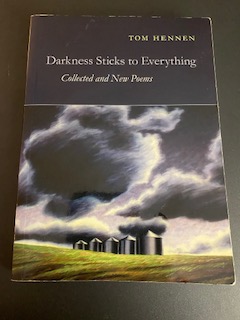
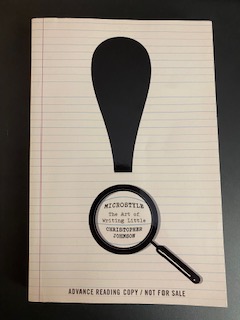
In terms of what I’ve been reading lately, when I gathered things up from one room and another, I wasn’t surprised. Pretty much all of it has been poetry and short fiction, even some nonfiction about the linguistic nuances of writing brief things that carry power. Not that I no longer want to read good long books. In fact, I’m itching to re-read some favorites like Nights at the Circus and The Sea The Sea. But below are some books of shorter things that I’m either reading at the moment, or have really enjoyed over the winter. Here’s to brief but mighty things!

Poetics, and a critical slant

Credit: M. Jakubowski


In all the years I’ve been a writer, the past year has been one of the most complicated, confusing, and – in the way writing often is – satisfying, nevertheless.

One thing I’ve learned and had to learn again is that sometimes I absolutely need to be journaling, everyday. So I did and as the months passed I filled an older journal and started a new one. A few months ago the entries were turning into… poems? And one of them seemed “good,” to me, a suspicion confirmed by a friend, who encouraged me to submit it. I did, and was shocked when it was accepted. My first traditional poem, ever. It’s out in the world now in Stone Circle Review. (Many thanks to the wonderful editor and poet Lee Potts for taking it on.)

Continue reading

Corner of the World

erasure image 3 jakubowski

Image 3 of 3 from “corner of the world”

The experimental work I posted about not too long ago not only has a name now, “corner of the world,” it was published (!) by 3:AM Magazine this week. (Many thanks to 3:AM poetry editor Steven J. Fowler.)

It’s three photos, of page fragments. Some photos are photos of a torn photo, repeated a couple times. The page fragments were torn from an uncorrected advance proof of a novel, which I reviewed (favorably, I should add). So no “art,” author’s reputation, or publisher’s investment was done any malice to create this. Continue reading

New story in Fiddleblack

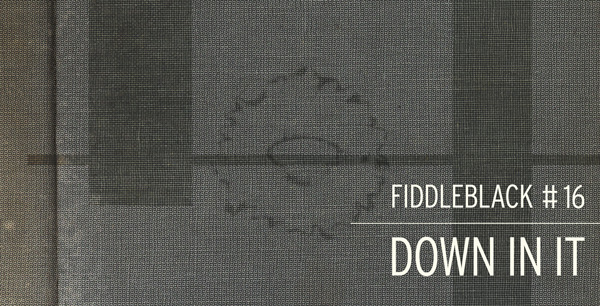
Very happy to say that my short story, “Sharpening the Sickle to Shame the Scythe,” appears in Issue #16 of Fiddleblack.

It’s about the way people cope with guilt during the grieving process. So it’s a bit different from the kind of short stories I’ve published thus far.

Many thanks to editor Jason Cook for publishing this piece. He wrote this introduction to the new issue, which features wonderful poems by Brian Kubarycz and Elias Marsten, and stories by Anna Boorstin, Maxwell Howard, and Caitlin Woolley.

Down in It: Fiddleblack #16

Here’s an excerpt from my piece. Thanks for reading. And of course I’d welcome a chance to hear your comments about the story.

In the hours before Lauren Hunter-Aikens got the news she was stuck trying to revise a story she had written in her creative therapy group.

In the story, the narrator imagined that the news of her son’s death would come by phone. She would be at work drinking coffee, clicking with intense focus through documents on her computer screen. Her phone would buzz in her purse. Not wanting to disturb the office silence, she would answer right away and keep her voice low out of respect for her colleagues on the other sides of her cube.

The voice would ask if she were sitting down. She’d say yes, why? The person who’d called would say the preliminary things she had feared for so long. Then the voice would tell her that there had been an accident. Most often she imagined the voice telling her there had been a car crash, but also very frequently it was an accident at home, where a nanny watched the boy until she and her husband got back from work around five-thirty. The boy had died in a fall down the stairs or been poisoned with household chemicals. A few times she imagined the boy had choked on something she and her husband had neglected to clean up, such as a penny or a tire from a broken toy car. In any case, in that scenario an everyday object in their home had somehow killed the boy. In the story, the woman would wail when she got the news, slamming her phone against the desk, causing the people in the cubes next to hers to jump up and look over the wall, asking what’s wrong, what on earth has happened?