through summer & into fall

fearsome-flora

Scary “best books of the year” lists are here. Dare to look away.

It’s been an eventful time lately.

In early summer I signed on with the wonderful Sarah Yake from the Frances Collin Agency. Just like that, my novel, which looked like this in early 2016, is now “making the rounds,” as they say, going out to great editors far and wide. It feels crazily amazing. So, good luck, novels, mine and all the others out there.

In August, I got to read for the first time in New York City, at Brooklyn’s Unnameable Books, to be exact, where I bought a copy of a Janet Frame novel for $7. The occasion was the launch of Vestiges_02 from Black Sun Lit. We heard from a fantastic group of writers and poets, and there was even a surprise appearance by Russell Bennetts, who just happened to be in town and was kind enough to stop by and celebrate. (In case anyone’s curious, I read this short piece from Minor Literature[s].)

I found out that I’ll have two short-short stories in The Brooklyn Rail. They’ll be published sometime in the next few months or so. One’s about love, the other’s about escaping death.

For The Kenyon Review Online, I wrote a review of Caren Beilin’s experimental novel, “The University of Pennsylvania,” from Noemi Press, 2014.

That’s it for now. Now on we go into fall reading and submission season, complete with those “best books of 2016” lists, which are popping up all over. I sort of love to hate them. I’ve said I won’t read them because they’re cruel to writers, just reductive clickbait designed to maximize holiday book-buying, but I do end up looking at a few. It’s hard not to feed the monster a little.
An interview with Daniel Evans Pritchard

What motivations shape a critic’s decisions to write about the books they defend and those they dismiss? And what are the ethical or moral dimensions of those decisions? Beyond mere conflicts of interest, what lines do they draw for themselves in their work? Are there personal forces or experiences that affect their preferences about what to read and review?

In this ongoing series of interviews with critics, one of the central questions will be, “What is a critic’s role?” It’s a broad question, open-ended, but one which can be used, if the critic chooses, to address the personal side to their lives as critics, and perhaps how they see their work affecting society and culture.

Daniel Evans Pritchard took the time recently via email to talk about some of these questions during a discussion that ranged from his reflections on the effect of focusing solely on writing by women and writers of color for a year to the possible fates of respected literary journals that refuse to address biases in the kind of writing they support.

Continue reading

translation

BTBA.jpg

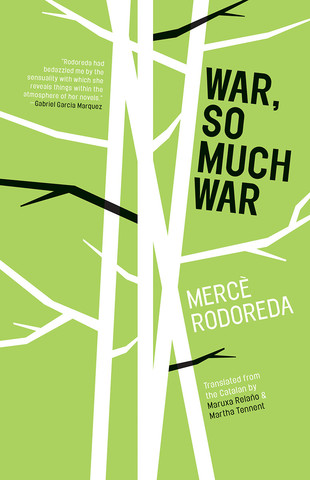
Three Percent announced the poetry and fiction longlists for the 2016 Best Translated Book Awards last week and while I know that two of my last four posts on this blog have been about Mercè Rodoreda, I still have to say it–hooray, Rodoreda made the longlist! It’s her novel, War, So Much War (Quanta, quanta guerra) translated by Martha Tennent and Maruxa Relaño. (My experimental review). If you haven’t already seen the full list of books, click on over to see who else made it (fiction longlist | poetry longlist) and be sure to follow the BTBA blog for guest posts by a fine array of people arguing why their favorite books should win.

Continue reading

Walk the novel

pages

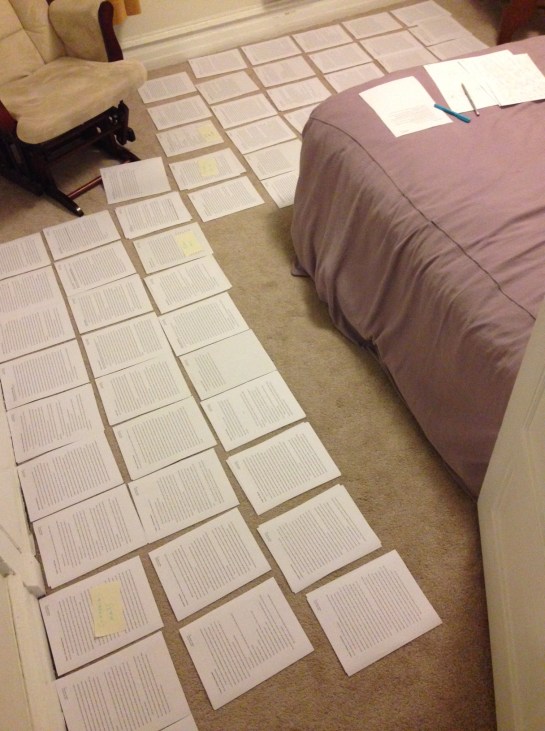
It’s been months since I posted anything but hey, I finished a draft of a new novel! At this stage it has a lot of short chapters, as you can see by this photo. It’s fun walking across the room and moving scenes around. This is the best way I know of to see the whole book, a very useful technique I shamelessly borrowed from novelist David Connerly Nahm

Oh, and last month I wrote an experimental review of Diane Williams’s new story collection, “Fine, Fine, Fine, Fine, Fine” for Minor Literature[s]

Okay, back to revising this novel. It’s going out to my first readers very soon.

And if you use any tricks or techniques like the one above when you’re revising a book, I’d love to hear about them.

Death, dreams & Dad

War_So_Much_War-front_large.jpg

Interfictions, the online journal of the Interstitial Arts Foundation, recently published its sixth issue and it includes a new piece I wrote.

It’s an experimental book review, the third one I’ve done. Part criticism, fiction, and memoir, it’s about all the things a good book shakes loose inside me, which tend to spill out in raw form and later become a short story masquerading as a book review, or vice versa.

The review focuses on Mercè Rodoreda’s new novel, War, So Much War, published in English for the first time by Open Letter Books, translated masterfully from the Catalan by Martha Tennent and Maruxa Relaño, who’ve collaborated on many books together.

Interfictions is a fantastic venue to work for. For one thing, they pay their writers. Which is nice but most of all I’m grateful I got to work with Sofia Samatar, whose editorial guidance made all the difference as this review took shape.

Thanks in advance if you get a chance to read my piece and some of the others at Interfictions–the short stories were chosen by guest editors Carmen Maria Machado and Sam J. Miller. And be sure to check out Rodoreda’s novel! It’s one of my top three books for 2015.

Reading in, reading out

IMG_0816

With summer behind us and “serious book” season going strong, it feels like a busy time. A couple fantastic books I read in October were VERTIGO, a story collection by Joanna Walsh, and THE WEIGHT OF THINGS, a novella by the late Austrian writer Marianne Fritz, which was translated by my friend and former Asymptote colleague Adrian Nathan West. I shouldn’t link to 27 things here, so I’ll just say there have been a lot of enjoyable reviews and author/translator interviews for both books. They were published by Dorothy Project, who releases a pair of books each fall, and it’s become a sort of a “can’t wait” moment for me each year. Their list already includes Renee Gladman, Azareen Van der Vliet Oloomi, Nell Zink, Joanna Ruocco, Barbara Comyns, and more.

In September, poet Paul Siegell invited me to read at Painted Pride Quarterly Presents: a reading series at the Black Sheep Pub in Philly. I got to read with poets Yolanda Wisher, Boston Gordon, and Hannah Litvin.

Back in August I organized and hosted a reading in Philly with five authors, including Scottish author Helen McClory, and local writers Asali Solomon, Ras Mashramani, Phillip Garcia, and poet Jasmine Combs.

Rather than drop 10,000 words here about what it means to me to have met these writers and heard from them in person at these two events, I’ll just say that nothing beats being able to shake hands with other Philly writers and hear how they survive and thrive as artists in this city. It felt like I got a chance to see again part of something vast and beautiful and made me proud to be a writer among them.

One last note, this Saturday at 1 p.m. I’ll be at the 215 Festival in Northern Liberties for a “Fake Histories” walking tour, where writers tell tall tales about real places. It’ll be a short walk but a lot of fun. So if you’re at the festival and need some fresh air and a laugh, come check it out. There are good spots nearby to grab a beer afterwards, too. It starts at 1 p.m. at Trophy Bikes (712 N. 2nd St.), will be hosted by Jaime Fountaine, and features journalist Max Marin and writer Alejandro Morales.